Most people who enquire about a grooming course have already spent hours watching tutorials online. They have a rough idea of the techniques, a sense of the tools, and a feeling that this is the direction they want to go. What they cannot find anywhere is an honest answer to the question that actually matters: what does it feel like when you show up? What happens on day one? What does it look like when something goes wrong? What do you actually leave with when it is over? This post answers all of that, based on what training at Hackney Barkers genuinely looks like from the inside.
Date
April 8, 2025
Author
Jade
READING TIME
8 min read
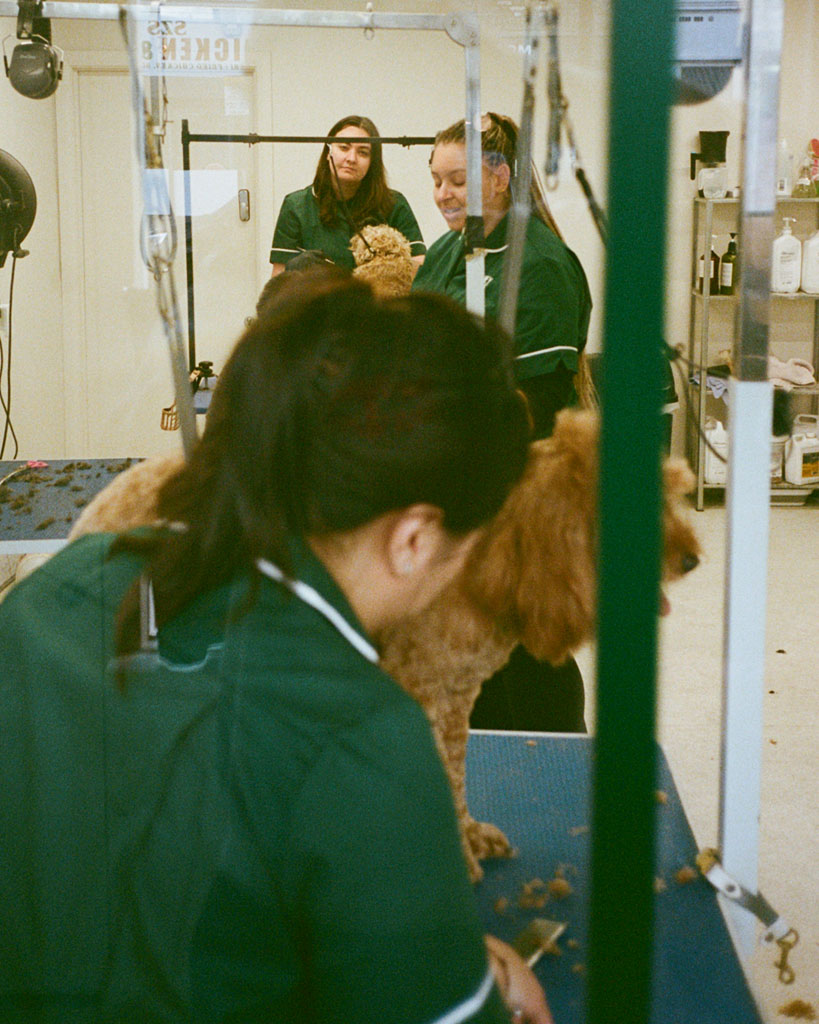
The first day starts slightly earlier than the rest of the course. There are two dogs scheduled every day throughout the programme, and the morning is needed for something just as important as the grooming itself.
When students arrive, the day begins with time. Time to walk through the salon, to understand how the space works, to meet the team, to go through the paperwork, to receive the handbook and the overview of what the course covers. Questions are welcome, and there is no rush. The point of the morning is to settle. To let the environment become familiar. To let people who might be nervous, excited, or both start to feel like they belong in the room.
Then comes the first dog.
The afternoon dog on day one is always handled by the tutor as a demonstration. The student watches the full workflow, the approach to the dog, the way the groom is structured from consultation through to finish. It is the first time most students see everything they have learned about in theory translated into practice in front of them. Some find it reassuring. Some find it overwhelming in the best possible way. Then the afternoon dog arrives, and the student gets to work.
That moment, the first real dog, the first real groom, is where the course truly begins.
It is where things get real. There is no version of this that is staged or softened. The dogs are real clients, booked in and trusted to the salon. The standard expected of the work is the same as any other appointment. Nothing can be hidden, skipped over, or rehearsed until it looks right. Everything happens in front of you, and you are part of it.
Some students rise to that moment immediately. Others feel the nerves first and find their footing over the following sessions. Both responses are completely normal, and both lead to the same place with time. What matters is that the experience is genuine from the very first afternoon. There is no point in the course where students are working towards the real thing. They are already doing it.
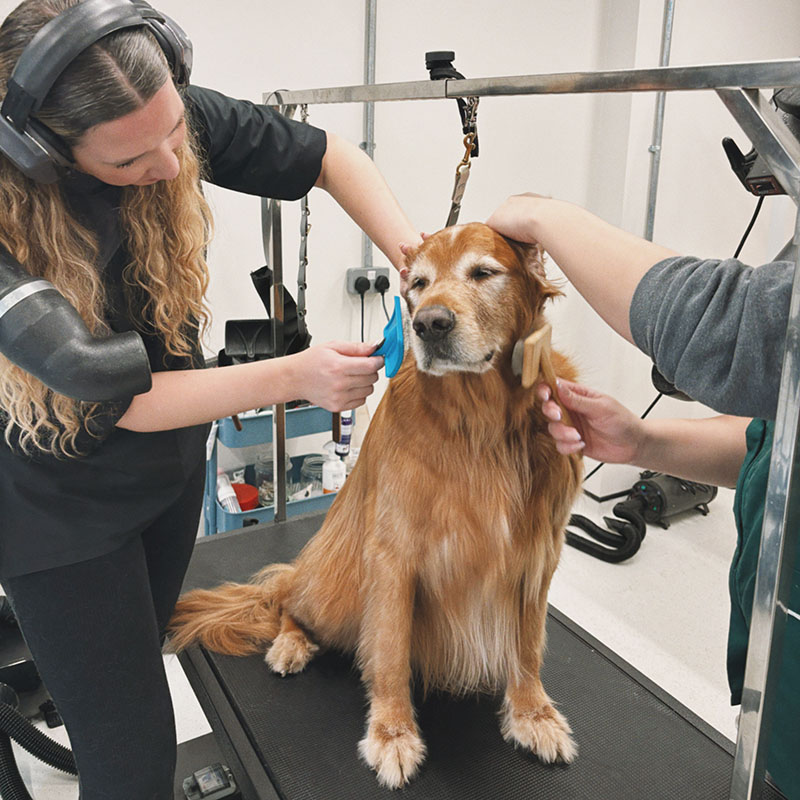
With a maximum of two students per tutor, the relationship is nothing like a classroom. There is no group to get lost in, no general feedback that might or might not apply to what you specifically did. The tutor is there, watching, guiding, and adjusting in real time based on what is actually happening in front of them.
But the real skill in teaching is knowing when to step back. Jumping in at every moment does not build a groomer. It builds dependency. The tutors at Hackney Barkers have been where every student is standing. They know what it feels like to hold scissors on a dog for the first time, to second-guess a cut, to read a dog's body language and wonder if they are reading it right. That experience shapes how they teach. They step in when it matters. They step back when stepping back is what the student needs to grow.
There is a genuine bond that forms. It is hard to describe without sounding like a cliché, but it is real. Watching someone move from uncertain to capable, from nervous to confident, over the course of their training is something that does not get old. These are people making a real change, whether that is a first career, a braver one, or a return to something they always knew they were meant to do. That does not go unnoticed.
It will. Not because the student is not good enough, but because every groomer who has ever worked at a high level has made a hundred mistakes on the way there. That is not a comforting platitude. It is simply true.
A cut that does not land right, a dog that moves at the wrong moment, a technique that makes sense in theory and resists you in practice. These things happen. How they are handled is what defines the learning.
At Hackney Barkers, the response to a mistake is never dismissal. It is experience shared. The tutor has been there. They know which mistakes are common, which ones feel worse than they are, and how to turn the moment into something the student actually retains. Some students shake it off easily. Others carry it harder. Either way, it is the job of the tutor to meet them where they are and bring them through it. Sometimes you win. Sometimes you learn. Both count.
There is a pattern that most students follow, and it is worth knowing about before you start.
In the early stages, many students arrive feeling like they know quite a lot. Hours of YouTube, grooming tutorials, breed research. They have done the preparation and it shows. Then reality arrives, and there is a period of genuine humility. The gap between watching something and doing it is wider than it looks from the outside, and the more students learn, the more clearly they can see how much more there is to learn. This can feel disorienting.
Then comes the moment that every tutor waits for. The click. It is different for every student and it arrives at different times, but when it comes it is unmistakable. The hands start to move with something approaching confidence. The dog is being read rather than managed. The decisions feel instinctive rather than calculated. The student who arrived uncertain is becoming a groomer. Watching that happen, from the beginning of the curve to the other side of it, is the part of teaching that never becomes routine.
Busy, warm, and completely honest. Clients come in throughout the day. Dogs arrive and leave. The team moves around each other with the ease of people who have shared a small space for a long time. Nothing about it is set up to look a certain way. It simply is what it is, a working salon that has been doing this since 2021 and has not changed much about how it operates since.
For a student, that environment is both the challenge and the point. There is no protected training space where the pressure is lower. There is just the salon, and you are in it. The connections that form in that space are real ones. Clients who have come through the door a hundred times stop to chat. The line between working there and belonging there blurs quickly. That is not an accident. It is what Hackney Barkers has always been.
The qualification is real and it matters. A City and Guilds credential is the industry standard and it goes with the student wherever they go, whether that is into a salon, onto a mobile van, or into a business of their own.
But the qualification is not the whole of it. Students leave knowing what it feels like to work to a genuine professional standard, not a training-room approximation of one. They leave with the confidence that comes from having done real work on real dogs in a real salon, not from having rehearsed for it. And they leave as part of something that does not end when the last session does.
The Hackney Barkers graduate community is small by design. Classes are intimate, the number of students trained each year is limited, and every person who has come through the school is known by name. Once the course ends, students join a connected group of graduates and have ongoing access to the team for questions, support, and guidance as their careers develop. The relationship does not stop at the door. Find out more about our dog grooming school.
The first day begins with an introduction to the salon, the team, and the course structure. Students receive their handbook, go through the programme overview, and have time to ask questions and settle into the environment. The tutor demonstrates a full groom on the first dog of the day, walking through the workflow and approach from start to finish. Students then take on the afternoon dog themselves, putting into practice what they have observed. It is a genuine first groom, not a practice run.
Completely. Most students arrive with a mix of excitement and nerves, and both are entirely appropriate given what they are about to do. Some rise to the first dog immediately. Others find their footing over the following sessions. The tutor is there throughout, adjusting their support to what each student actually needs rather than delivering the same experience to everyone. Nerves are part of the process. They do not last.
At Hackney Barkers, yes. Every dog students work on throughout the course is a real client dog, booked into the salon and treated to the same standard as any other appointment. There is no separate training environment. Students are part of the working salon from their first session.
Students leave with a City and Guilds Level 2 Certificate, a City and Guilds Level 2 and 3 Diploma, or both, depending on which course they have completed. City and Guilds is the most recognised grooming qualification in the UK and carries genuine weight with professional salons and clients. Both courses are completed inside the working salon, with a maximum of two students per tutor throughout.
Graduates join a connected community of Hackney Barkers alumni and have ongoing access to the team for questions, advice, and support as their careers develop. The relationship does not end with the qualification. Classes are small and the number of students trained each year is intentionally limited, which means every graduate is known and the support offered after the course is genuine rather than generic.
Yes, and it is more common than most people expect. Students come to Hackney Barkers from a wide range of backgrounds and at different stages of life. What they share is the decision to do something that feels meaningful. The course is designed to take someone with no previous experience to full professional qualification. What you bring with you, whether that is life experience, professional discipline, or simply a genuine love of dogs, becomes part of how you develop as a groomer.
Author: Written by Jade, lead groomer and founder of Hackney Barkers.
Published: April 2026 Last reviewed: April 2026
July 10, 2026
July 6, 2026
July 6, 2026


