If you have a wire-haired terrier, a schnauzer, or a spaniel, there is a good chance you have been asked this question at a grooming salon, or asked it yourself. Hand stripping and clipping are not two ways of achieving the same thing. They are fundamentally different techniques that produce different results, affect the coat differently over time, and are suited to different dogs. Getting this wrong does not just affect how your dog looks after a groom. It can affect the condition and character of their coat permanently. This post explains the difference clearly so you can make the right decision for your dog.
Date
April 8, 2025
Author
Jade
READING TIME
5 min read
Hand stripping is the process of removing dead coat from the root by hand, rather than cutting it with scissors or clippers. The groomer works through the coat using their fingers and thumb, a stripping knife, or a stripping stone, following the direction of coat growth. The stripping knife is worth a brief mention here because the name can sound alarming. It is not an actual knife and it does not cut the hair. It is a tool that helps professional groomers work more efficiently, but the entire groom can be done using fingers and thumb alone.
The technique works with the coat's natural growth cycle. Hair goes through four stages: a growth stage, a transition stage where growth slows and the hair begins to detach from its blood supply, a resting stage, and finally a shedding stage. In wire-haired and coarser coated breeds, the transition stage is when hand stripping is most effective. The dead coat has naturally loosened at the follicle and is ready to be removed. A skilled groomer can feel the difference between live and dead coat almost immediately. Done correctly and at the right time, hand stripping causes no discomfort whatsoever, because you are only ever removing hair that is already naturally releasing.
The result is a coat that grows back with its natural texture, colour, and protective qualities fully intact.
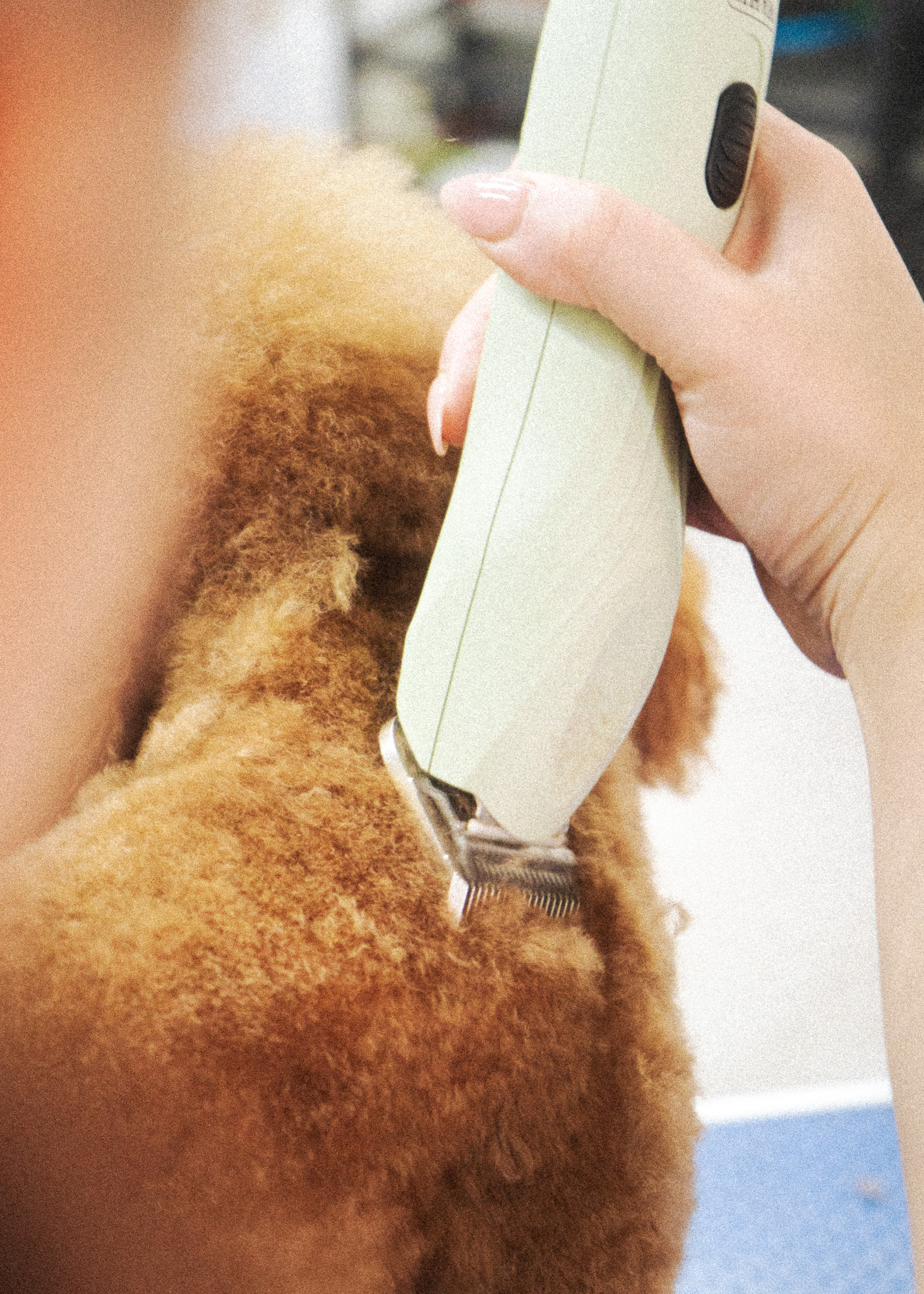
Scissoring uses scissors to cut the hair to a desired length or shape. Clipping uses electric clippers to do the same thing more quickly across larger areas. Both cut the hair partway through its growth cycle rather than removing it from the root. For breeds with continuously growing coats, such as Poodles, Bichon Frises, and most Doodle crosses, this is exactly the right approach. The coat is designed to be cut, and regular scissoring or clipping keeps it manageable and healthy.
For these coats, our clip and scissor finish groom is exactly the right approach.
The issue arises with wire-haired and spaniel breeds whose coats are not designed to be cut.
A wire coat has a coarse, harsh outer layer of guard hairs and a softer undercoat beneath. When the outer coat is hand stripped correctly, only the dead coat is removed from the root. The follicle receives a signal to begin a new growth cycle, and the coat that grows back comes in with the same coarse texture and natural colour as before.
When a wire coat is clipped, the hair is cut through its growth cycle rather than removed at the root. The dead hair remains lodged in the follicle. What grows back is progressively softer, fluffier, and less like the coat the breed is meant to have. The natural colour dulls. The texture changes from harsh and weather-resistant to soft and woolly. The coat loses the qualities it was bred to have.
After a wire-haired dog has been clipped repeatedly, the coat often becomes unsuitable for hand stripping altogether. The change can be permanent. This is why the decision matters, and why it is worth understanding before the first groom rather than after several.
Spaniels are not wire-haired breeds, but many of them, particularly English Cocker Spaniels, Springer Spaniels, Field Spaniels, and Sussex Spaniels, have a working coat that is designed to be hand stripped. Understanding why requires understanding what the spaniel coat is actually made of.
Spaniels have a double coat. A soft, dense undercoat sits beneath a topcoat of longer guard hairs. Depending on the breed, the topcoat ranges from flat and silky in a Cocker Spaniel to slightly wavier in a Springer or Field Spaniel. Like wire coats, the topcoat has a natural growth cycle. The dead coat loosens at the follicle and is ready to be removed. Hand stripping takes it from the root cleanly, allowing healthy new coat to grow through properly. Clipping cuts through both live and dead hair, leaving the dead coat lodged in the follicle.
The consequences for a spaniel coat that has been clipped repeatedly are significant. The coat becomes soft and woolly rather than flat and naturally textured. It loses its colour pigmentation, fading noticeably over time. It becomes prone to matting and far less weather-resistant. A coat that was designed to protect a working dog from rain, mud, and dense undergrowth loses those qualities progressively with each clip. Once a spaniel coat has been clipped repeatedly, restoring its original texture is very difficult and sometimes not possible at all.
When a spaniel is hand stripped correctly, the goals are specific. The coat lies flat and tight to the body on the back and body, with the feathering on the ears, chest, belly, and legs looking neat, flowing, and healthy rather than puffed out. The natural coat colour holds its rich depth. The follicles function as they should, producing coat that is dense, correct, and manageable long term. For spaniels being shown, hand stripping is not optional. The breed standard describes a coat type and outline that cannot be achieved any other way.
As a general rule, any breed with a traditional wire, harsh, or working guard coat. The most common include Border Terriers, Welsh Terriers, Fox Terriers, Lakeland Terriers, Irish Terriers, West Highland White Terriers, Schnauzers in all sizes, Wire-Haired Dachshunds, Wire-Haired Vizslas, English Cocker Spaniels, Springer Spaniels, Field Spaniels, and Sussex Spaniels.
If you are unsure whether your dog's coat calls for hand stripping, ask your groomer before booking. They should be able to tell you from the coat texture and breed history. If a groomer does not ask about coat type or grooming history before reaching for clippers on any of these breeds, that is worth paying attention to.
When done correctly and at the right time, hand stripping is completely pain-free. The dead coat is removed because it has naturally loosened from the follicle. It is not pulled against resistance.
A dog that shows discomfort during hand stripping is usually one of two things: a dog whose coat is not at the right stage and is being stripped too early, or a dog reacting to the unfamiliarity of the process rather than any actual discomfort. An experienced groomer will assess the coat before beginning and work at a pace that keeps the dog settled throughout. At Hackney Barkers, every hand stripping appointment starts with an assessment. No grooming begins until we are confident the coat is ready and the dog is comfortable. Find out more about our hand stripping service.
Not every dog is, even within breeds that traditionally require it. Grooming history is the most significant factor. A dog that has been clipped repeatedly may have a coat that is no longer suitable, as the texture and follicle condition will have changed. In some cases a transition back to hand stripping is possible over time, but this depends entirely on the individual coat.
Neutering can also affect coat quality. Hormonal changes following neutering sometimes soften the coat and alter its natural character, which affects whether hand stripping produces the results it should. Age matters too. Elderly dogs or those with sensitive skin may find the process harder to tolerate, even when handled gently.
If there is any doubt about suitability, the right approach is an assessment before a full appointment is booked. That conversation protects the dog, manages expectations, and means the groom itself goes smoothly.
For most breeds, hand stripping every eight to twelve weeks is the right range. Dogs on a rolling maintenance programme, where smaller amounts of coat are removed at regular intervals rather than a full strip at longer intervals, may need attention every six to eight weeks. Leaving it too long means dead coat becomes tangled with new growth, making the process harder for both dog and groomer.
Starting puppies young makes a significant difference. Getting them comfortable with the sensation of hand stripping early means it becomes a familiar and manageable part of their routine rather than something they resist as adults. Between appointments, a wide-toothed comb used gently through the coat helps keep it tidy and removes loose hair that has naturally shed. Ask your groomer which tools are right for your dog's specific coat and coat stage.
Hand stripping removes dead coat from the root by hand, allowing new healthy coat to grow through naturally. Clipping cuts the hair at a set length using electric clippers. For wire-haired and spaniel breeds, hand stripping preserves the coat's natural texture, colour, and protective qualities. Clipping these breeds gradually softens the texture, dulls the colour, and weakens the coat over time, and with repeated clipping the change often becomes permanent.
When done correctly and at the right stage of the coat's growth cycle, hand stripping causes no discomfort. The dead coat is removed because it has naturally loosened from the follicle, not pulled against resistance. A dog that reacts during hand stripping is usually reacting to unfamiliarity, or the coat is being stripped before it is ready. An experienced groomer will assess the coat before starting and work at a pace that keeps the dog comfortable throughout.
It depends on the condition of the coat. A dog that has been clipped once or twice may still be a candidate for hand stripping, though the coat may need time to recover its natural texture. A dog that has been clipped repeatedly over many years often has a coat that is no longer suitable, as the texture and follicle condition will have changed significantly. An assessment by an experienced groomer is the only way to know for certain.
Many spaniel breeds, including English Cocker Spaniels, Springer Spaniels, Field Spaniels, and Sussex Spaniels, have a working coat that is designed to be hand stripped. Clipping these breeds removes hair without clearing the follicle, which over time causes the coat to become soft, woolly, dull in colour, and prone to matting. Hand stripping preserves the coat's flat, natural texture, its colour, and its ability to protect the dog from the elements.
Despite the name, a stripping knife is not an actual knife and does not cut the hair. It is a grooming tool that helps professional groomers work more efficiently through the coat. The entire hand stripping process can be done using fingers and thumb alone. The stripping knife simply allows the groomer to maintain better grip and work more consistently across larger areas of coat.
Most wire-haired terrier breeds traditionally require hand stripping, including Border Terriers, Welsh Terriers, Fox Terriers, Lakeland Terriers, Irish Terriers, and West Highland White Terriers. Wire-Haired Dachshunds, Schnauzers in all sizes, and Wire-Haired Vizslas also fall into this category. If you are unsure about your specific breed, ask your groomer before booking.
Author: Written by Jade, lead groomer and founder of Hackney Barkers.
Published: April 2026 Last reviewed: April 2026
July 10, 2026
July 6, 2026
July 6, 2026


